


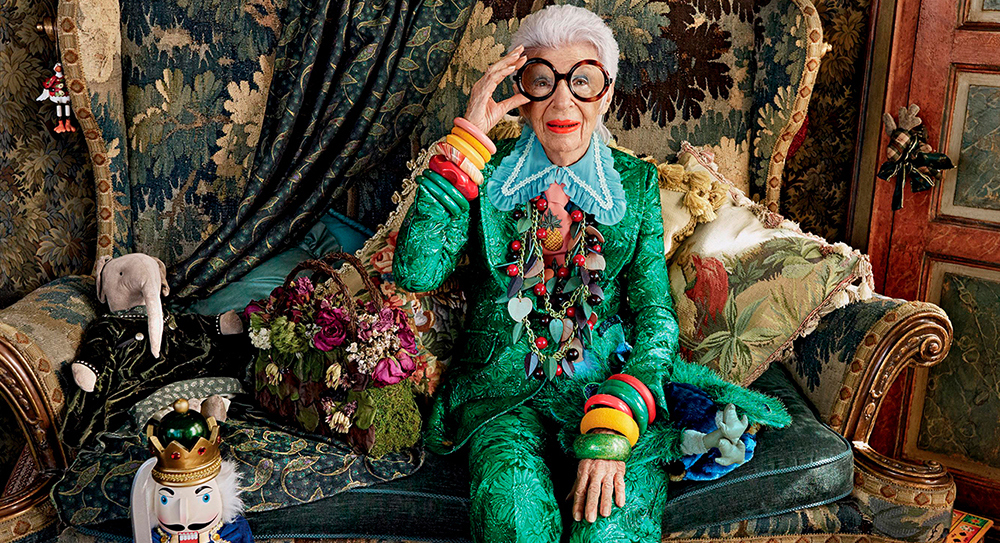
Iris Apfel was a woman who turned excess into art. She never fit into any framework: she mixed haute couture with flea-market finds, 19th-century décor with contemporary prints and every one of her looks felt completely natural. Long before the word “dopamine” became a fashion buzzword, she was already living by its principles.
In this article, we explore who the queen of maximalism was, how her life unfolded, and why her approach to interiors and décor remains one of the strongest references for designers today.
Who Was Iris Apfel: From New York to the White House
When Iris Apfel was born — on August 29, 1921 — New York was roaring with jazz, neon signs, and the newly imposed Prohibition, which everyone cheerfully ignored. It was a city where immigrants from all over the world lived side by side, and each neighborhood had its own color, sound, and scent. It’s hard to imagine a better cradle for a future queen of excess.
Her father was in the business of supplying glass and mirrors, while her mother owned a clothing boutique — and it was her mother who first taught her to think of style as a language, not a set of rules. “If you want to wear something — choose a little black dress. You can always dress it up or down,” she would say.
As a teenager, Iris traveled all over New York by subway — Chinatown, Harlem, Greenwich Village. In the city where she was born, browsing antique shops in search of accessories was more than just an interesting hobby. Many young women chasing the New York dream of becoming artists or actresses were drawn to design. Not taking advantage of flea markets would have been a real crime they allowed you to look unique for next to nothing. Iris’s first find was a brooch for 65 cents. That’s how a collection began — one that would eventually grow to thousands of pieces.
After studying art history at New York University, she worked as an editor at Women’s Wear Daily, and later as an assistant to an interior designer. In 1950, she and her husband Carl Apfel founded the textile company Old World Weavers, specializing in reproducing rare fabrics from the 17th to 19th centuries. Their clients included nine U.S. presidents — from Truman to Clinton.
Where She Was Born and How Her Design Vision Took Shape
New York in the 1920s was a city of contrasts, where immigrants from dozens of countries lived side by side — each with their own aesthetic and way of seeing objects as part of a larger story.
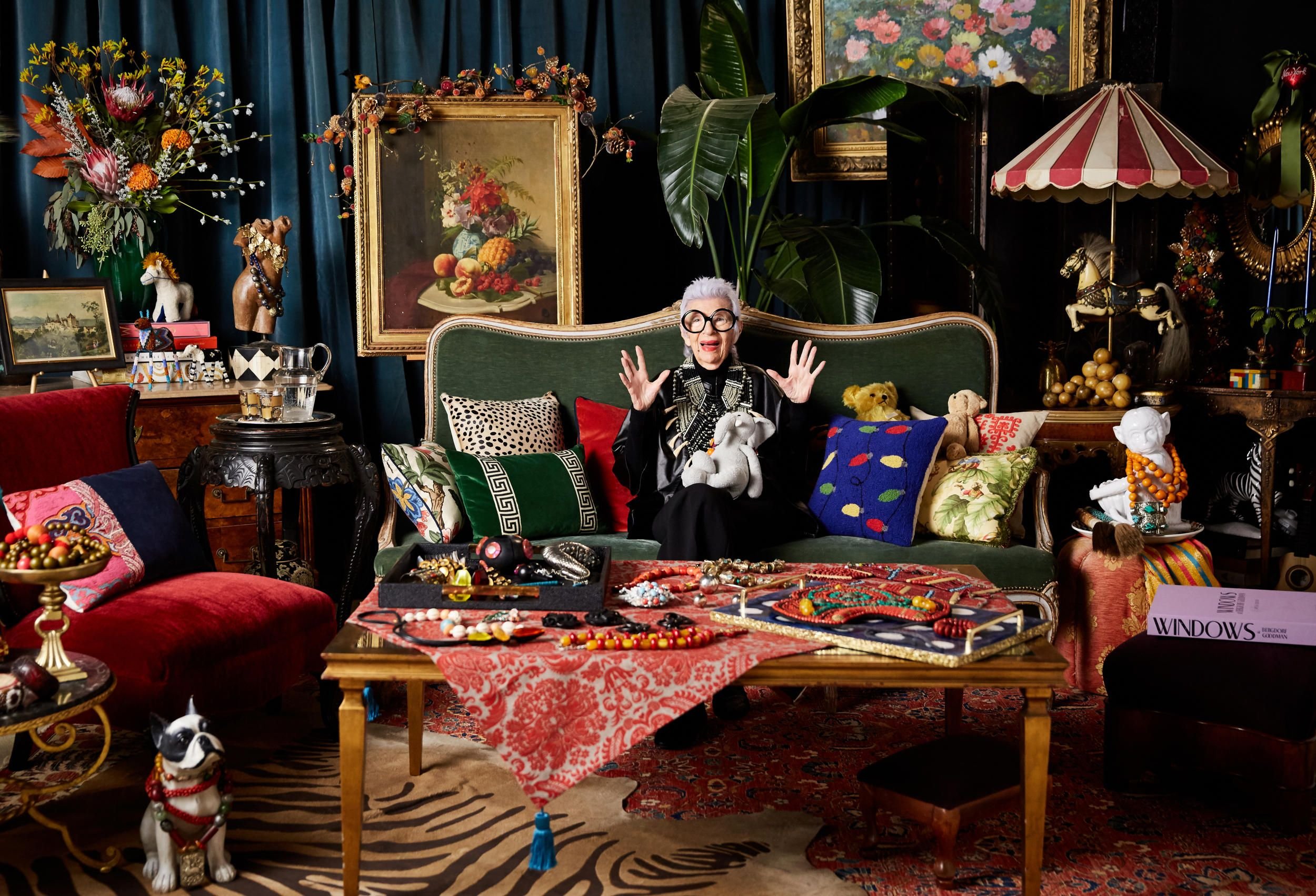
For Iris, textiles were never just materials — they were cultural documents. Traveling the world with Carl, she collected rare fabrics, clothing, and jewelry in India, Morocco, Turkey, Japan and all of it later became part of interiors, collections, or her personal style. Iris Apfel never divided things into “expensive” and “cheap” — only into “interesting” and “uninteresting.”
This is precisely the foundation of what is now called the dopamine approach to design: not minimalism for the sake of order, but richness for the sake of joy.
Why Iris Apfel and Dopamine Interiors Are Inseparable
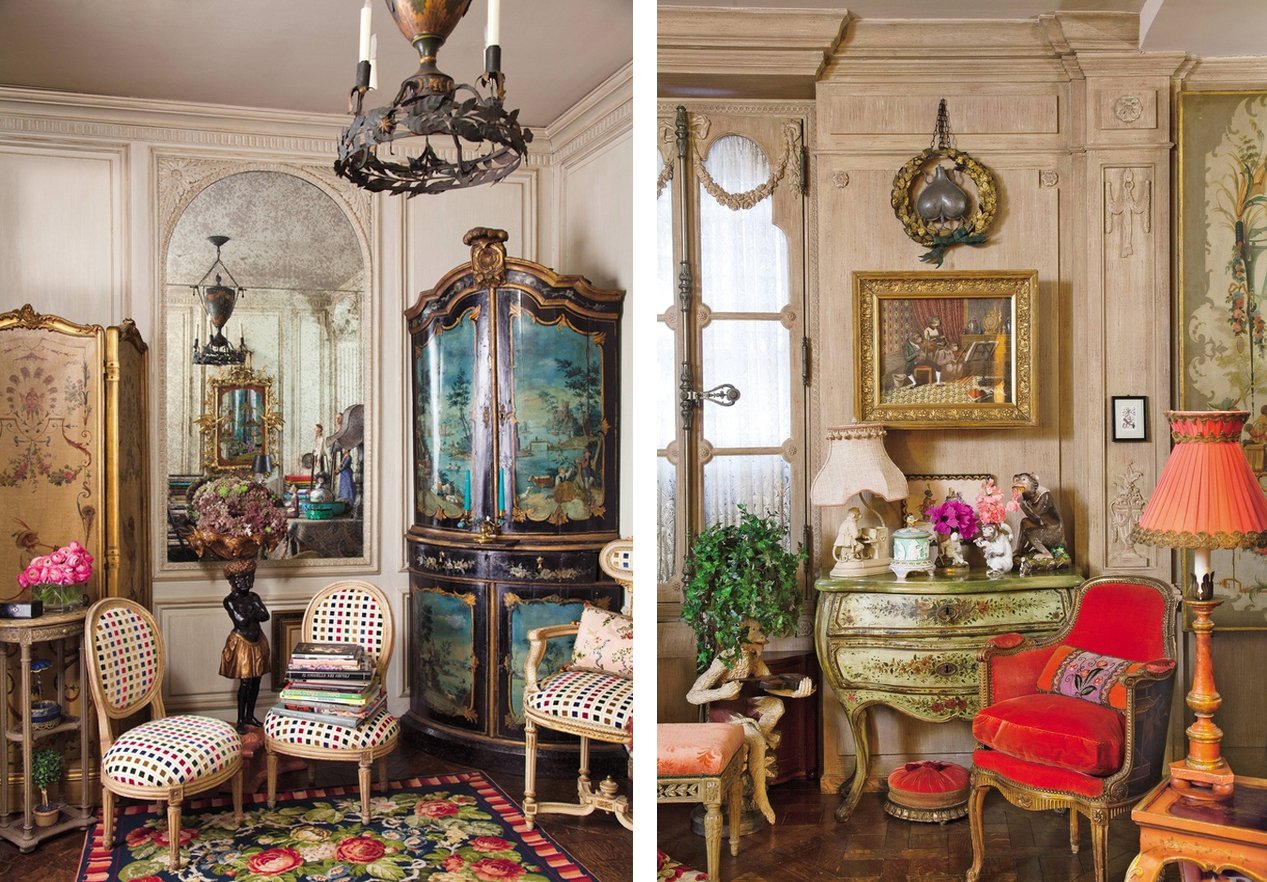
A dopamine interior is a space that literally lifts your mood. Bright colors, unexpected combinations of textures, objects with character and personal history. The term comes from psychology: dopamine is released when we experience something pleasant or stimulating and certain visual choices truly trigger that response.
The connection between Iris Apfel and dopamine interiors is not metaphorical — it’s entirely practical. Her own home in Palm Beach was a living example: walls covered in textiles, shelves filled with thousands of accessories, furniture from different eras, color everywhere. Not a single “neutral” surface for the sake of neutrality.
Key principles of her interior approach:
- Color as the main tool. Not just an accent wall, but color as a full participant in the space.
- Mixing eras. Antique furniture next to modern textiles is not eclecticism for shock value — it’s a dialogue between times.
- Textiles as the foundation of décor. Rugs, pillows, curtains, upholstery — for Apfel, these were not background but substance.
- Personal objects as décor. Collections, souvenirs, finds — anything meaningful deserves to be visible.
Iris Apfel and Dopamine Décor: The Principle “More Is More”
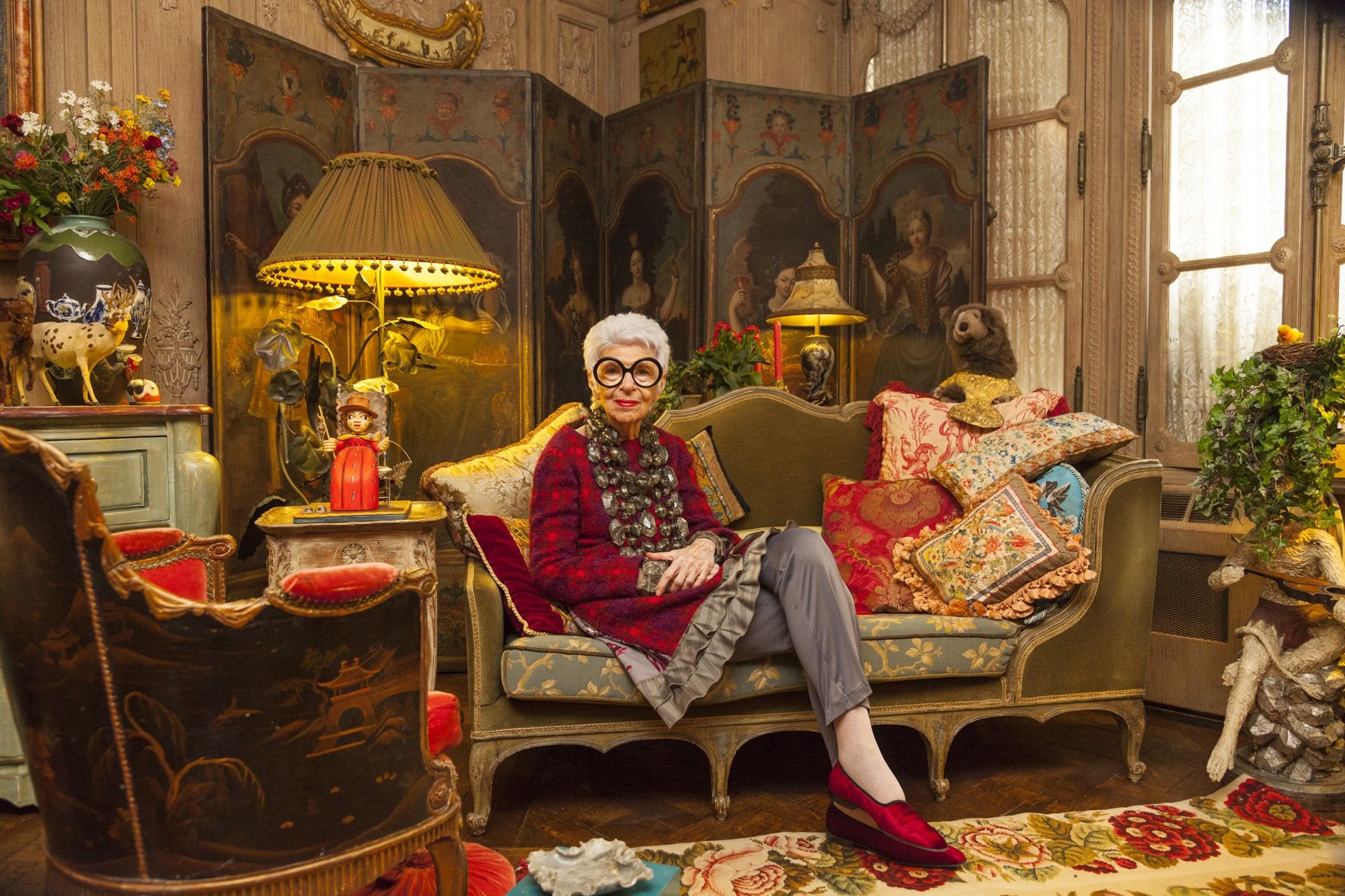
“More is more, and less is a bore” is one of Apfel’s most famous quotes. In décor, it doesn’t mean chaos — it means courage. Iris Apfel and dopamine décor are, above all, about understanding that the fear of “overdoing it” often prevents us from creating a truly vibrant space.
In practice, it looks like this:
Layering. Multiple rugs layered on top of each other. Several rows of artwork on a wall. A table filled with candles, flowers, and a strange sculpture brought back from a trip.
Unexpected details. One object that stands out from the overall theme, but is precisely what makes the interior unforgettable. For Apfel, it might have been an antique African headdress on a modern shelf.
Bold color combinations. Not a “safe” beige with a single bright accent, but a real clash of colors — where none dominates by force, only through balance.
Apfel’s ideas work not only for large spaces. Even a small apartment can become expressive if it has at least one “character corner” — a place filled with meaningful objects and room for color.
Iris Apfel’s Influence on Fashion and Design: A Living Legacy
It’s hard to overestimate the contribution of the queen of dopamine to the evolution of maximalism, not because she invented a style, but because she convinced entire generations that rules do not exist.
The 2005 exhibition “Rara Avis (Rare Bird)” at the Costume Institute of the Metropolitan Museum of Art was the first time such an honor was given to a living woman who was not a fashion designer.
After the exhibition, she became a media star at 84. At 97, she signed with the IMG modeling agency. She collaborated with MAC, Swarovski, Happy Socks, and Nude. More than three million people followed her on Instagram.
But that’s not the most important part. What matters is that Iris Apfel changed the very conversation about style in both fashion and interiors. She proved that a good space and a good outfit are not about budget or brand. They are about attention: to details, to personal taste, to objects with character.
On March 1, 2024, Iris Apfel passed away at the age of 102. But the principle of “more joy” remains.
What to Take from Apfel’s Philosophy for Your Own Interior
If you want to bring Iris Apfel’s ideas into your space, start not with shopping, but with a question: what in this room brings me joy? Everything else is background.
A few practical steps:
1. Add one object with a personal story — a vintage vase, a rug from your travels, or an old postcard in a frame. Objects with a past make an interior feel alive.
2. Don’t be afraid of color. Even one bright pillow or wall can completely change the mood of a room.
3. Mix styles intentionally. A modern sofa with a vintage table is not a mistake — it’s a choice. The key is a shared element: color, texture, or proportion.
4. Create a “power spot.” A shelf or table with a few things you love no strict system, just a sense of harmony.
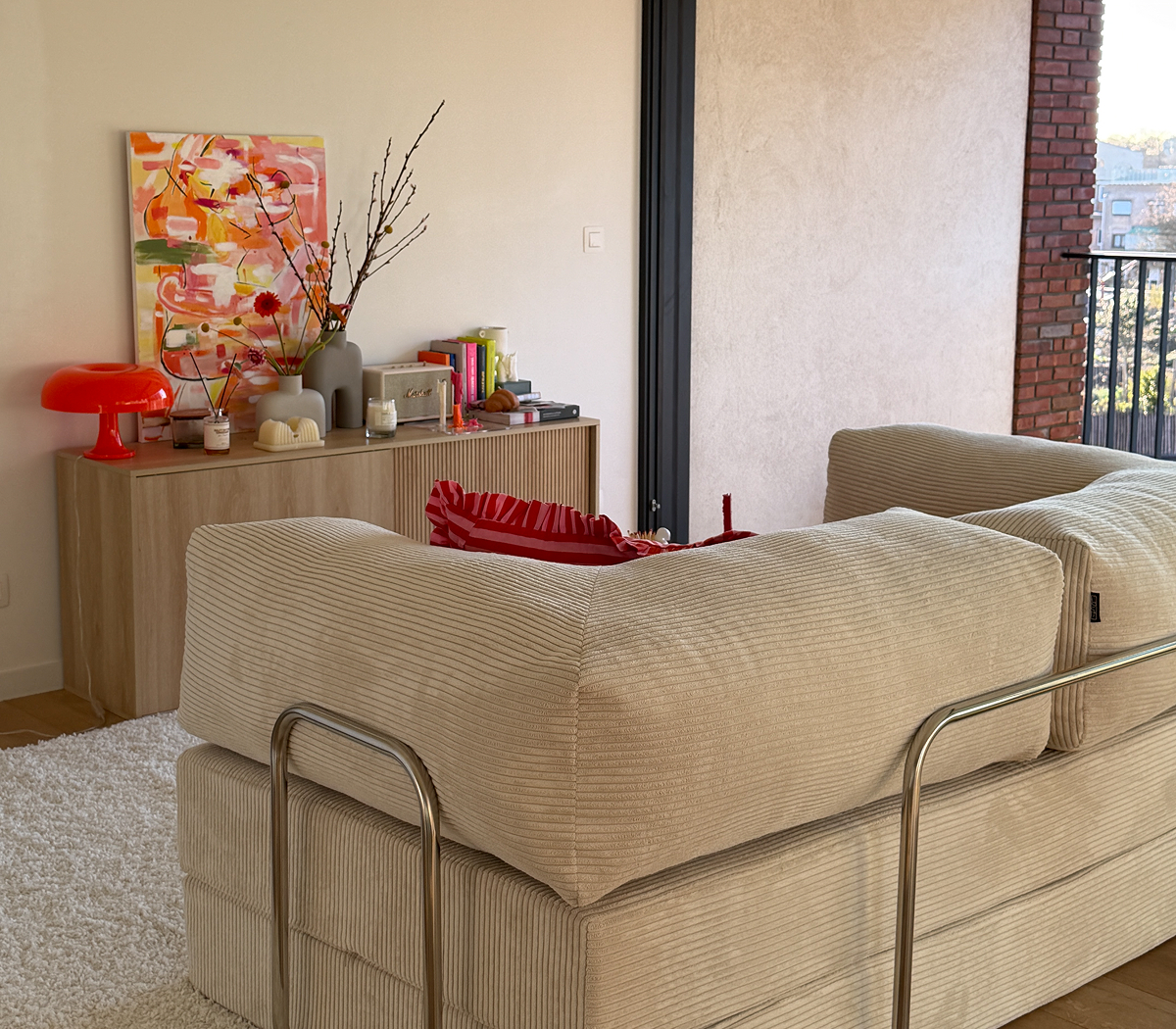
Apfel used to say that objects should tell the story of the person who lives with them. Furniture is not decoration or background — it is the framework around which your personal, character-filled space is built. Just as Iris Apfel taught: choose what has meaning for you — and don’t apologize for it.